Which haircut suits a man's face shape? Two measurements decide it, and a barber can work from the numbers
Most guides for men describe a face as strong or soft and leave it there. Two numbers separate the seven shapes, both can be taken with a tape measure in about a minute, and the thresholds are published on this page so the working can be checked.
Last reviewed 11 August 20267 min readSravya
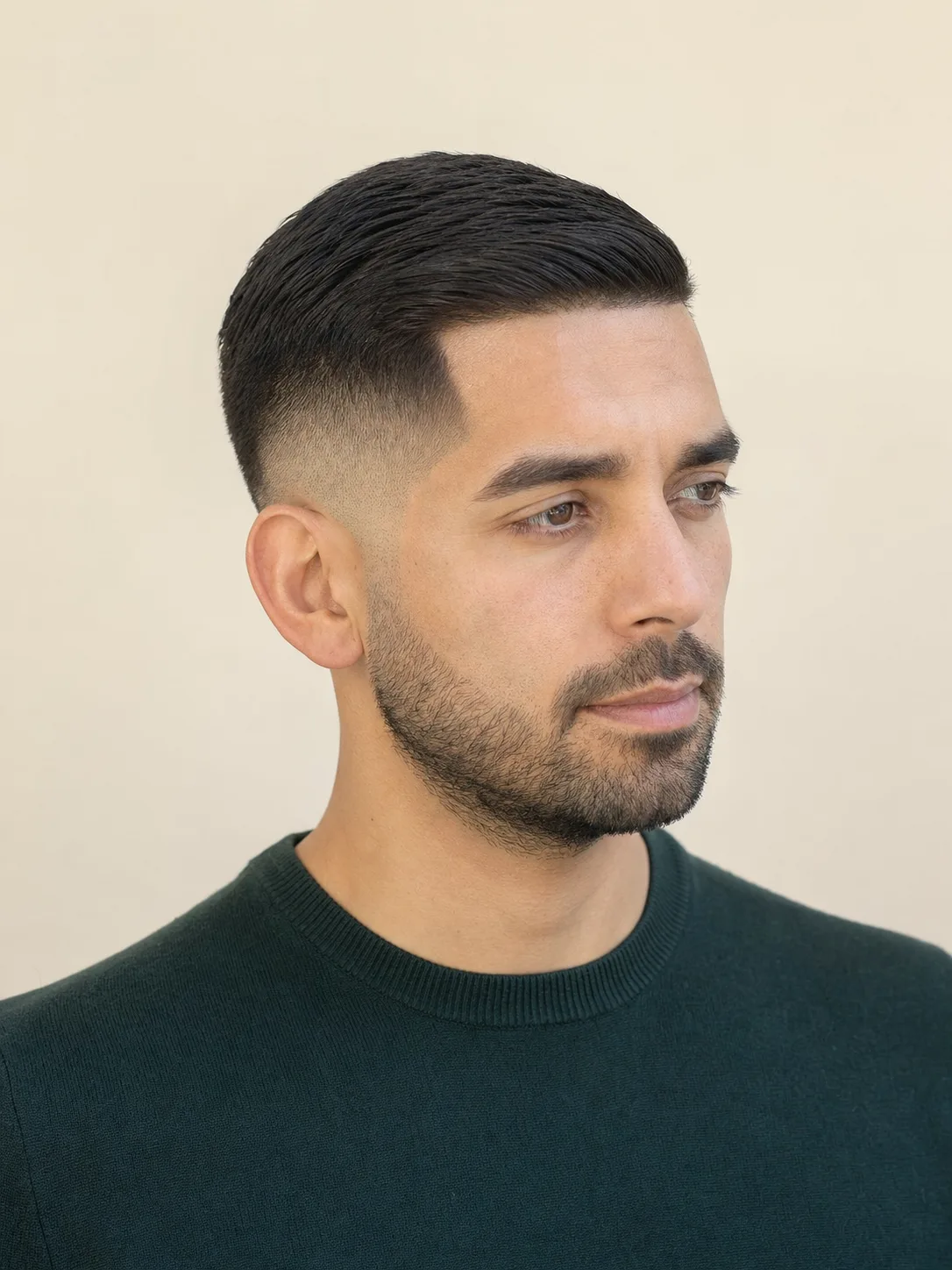
- 7 of 10
- Cuts that suit an oval face
- 3 of 10
- Cuts that suit a round face
- 2
- Measurements that settle it
The most accommodating shape, which is why it gets used as the reference.
The narrowest field of the seven, and the reason a round face gets bad advice.
Face length over cheekbone width, and jaw width over cheekbone width.
The short version
Two divisions do the work. Measure your face from hairline to chin and divide by the width across your cheekbones: under about 1.10 the face is as wide as it is long and reads round or square, over about 1.58 it reads oblong. Then measure across your jaw, below the ears, and divide by the same cheekbone width: under about 0.72 the jaw is clearly tapered, over about 1.02 it is the widest part of your face. Everything else is a combination of those two calls. A cut then either repeats what those numbers already say, or offsets it, and repeating is what makes a haircut look wrong on a man who suits it in the photograph.
01Take the two measurements
A soft tape measure and a mirror. Hair back off the forehead and off the ears, because hair covering either one is the single most common reason a home measurement comes out wrong.
- 1Face length: from your hairline down to the bottom of your chin, straight down the middle.
- 2Cheekbone width: across the widest point of your face, which is usually level with the outer corner of each eye.
- 3Jaw width: from one jaw corner to the other, below the ears, following the bone rather than the neck.
- 4Divide face length by cheekbone width. Divide jaw width by cheekbone width. Those two figures are the whole answer.
02Read the two numbers against the thresholds
These are the centres the tool on this site scores against. They are editorial thresholds rather than anthropometric norms, which is exactly why they are printed rather than hidden: a reader can disagree with a number they can see.
| Shape | Length over cheek | Jaw over cheek | What it means in a mirror |
|---|---|---|---|
| Round | 1.06 | 0.88 | As wide as it is long, with a soft jaw |
| Square | 1.10 | 0.97 | As wide as it is long, jaw as wide as the cheekbones |
| Triangle | 1.16 | 1.02 | Jaw the widest part of the face |
| Heart | 1.22 | 0.72 | Broad brow tapering to a narrow chin |
| Diamond | 1.27 | 0.74 | Cheekbones widest, brow and jaw both narrower |
| Oval | 1.38 | 0.82 | Longer than wide, jaw gently tapered |
| Oblong | 1.58 | 0.84 | Distinctly longer than wide |
Round and square differ only in the jaw. Their length figures sit within four hundredths of each other, which is inside anyone's measuring error, so the jaw division is the one that decides.
03What a cut does to each number
A haircut cannot change a face. It changes the outline around it, and only in two directions worth naming.
- Height at the crown adds to apparent face length. It helps a round or square face and works against an oblong one.
- Width at the sides adds to apparent width. It helps an oblong face and works against a round one.
- Length past the jaw draws attention to the jaw. That suits a face with a tapered jaw and fights one that is already widest there.
- Exposing the jaw completely, with very short sides, states whatever the jaw measurement already says. On a wide jaw it emphasises width rather than hiding it.
04How many cuts actually suit each shape
Counted from the ten masculine cuts in the gallery on this site. The spread is the point: an oval face suits 7 of them and a round face suits 3, which is why generic advice reads as useful to some men and useless to others.
| Shape | Cuts that suit it | What the shortlist has in common |
|---|---|---|
| Oval | 7 | Almost anything, which is why it is the reference rather than a goal |
| Square | 5 | Texture on top, nothing that squares off the outline further |
| Heart | 4 | Weight kept low, near the jaw, rather than piled at the crown |
| Diamond | 4 | Width at the brow and the jaw, not at the cheekbones |
| Triangle | 4 | Volume high, sides kept off the jaw |
| Oblong | 3 | Width at the sides, height kept down |
| Round | 3 | Height at the crown, sides tight, nothing rounded |
A low count is not a verdict on the face. It means the popular cuts of the moment happen to sit against those proportions, which is worth knowing before sitting in the chair rather than afterwards.
05What to say to a barber
A barber works in lengths and guards, not in shape names. Naming the shape is less useful than naming the effect, and the two numbers give the effect directly.
- If the length figure is low, ask for height at the crown and the sides kept tight.
- If the length figure is high, ask for the sides left with some weight and the top kept down.
- If the jaw figure is high, ask for the volume above the ear rather than below it.
- If the jaw figure is low, weight near the jaw is available and usually flattering.
- Say the numbers out loud. A barber who is told the jaw measures the same as the cheekbones understands the face faster than one told it is a square.
Common questions
Sources
Every figure quoted above is listed here with what it was used for and when the source was last checked. Anything not attributed to a source is this site’s own reading and is labelled as such where it appears.
Matrix
How To Choose The Best Hairstyle For Your Face ShapeThe qualitative definitions of each face shape, and the convention that a cut is judged by what it does to the outline rather than by the cut alone.
Last checked 11 August 2026
Check it against your own measurements
The gallery filters to masculine cuts and to a length, and every entry names the shapes it suits and the one it fights. It uses the same thresholds this page prints, so the shortlist and the reasoning are the same thing.
See the cuts for your shapeRead next
- All seven face shapes for menthe identification guide, with every ratio printed
- Measure it from a photo insteadFour widths read in your browser, nothing uploaded.
- See the cuts for your shapeFilter the gallery to masculine and pick a length.
- The most searched haircuts of 2026Nine cuts ranked, matched to the shapes they suit.