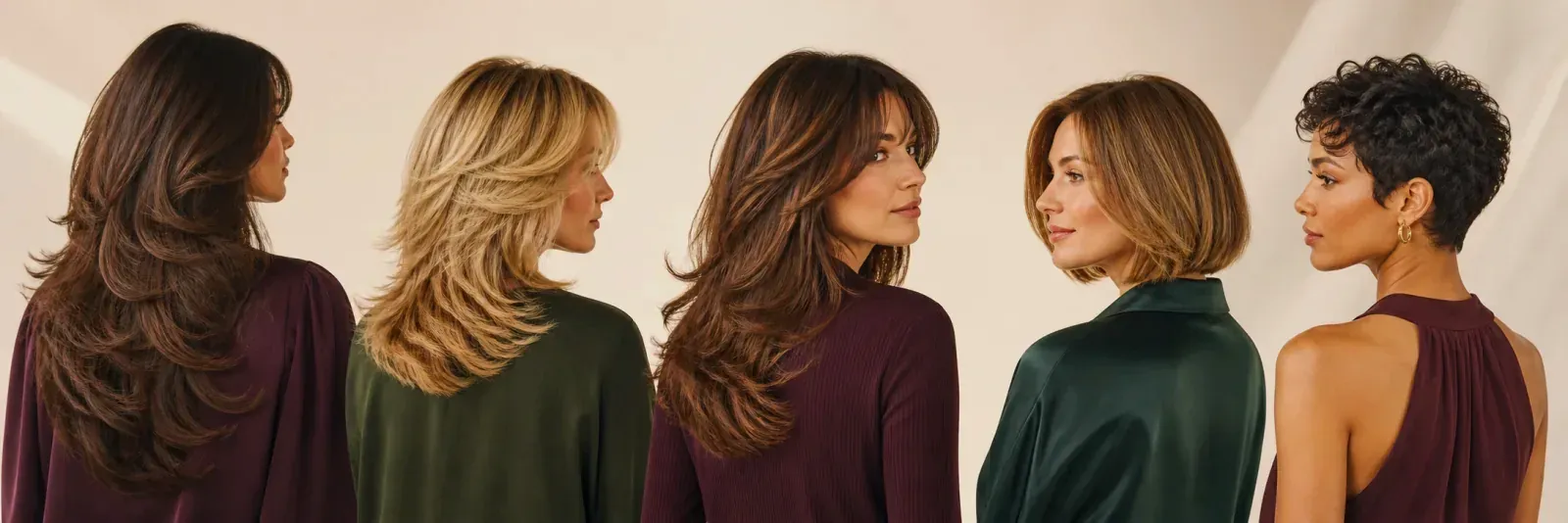
What haircut suits me starts with placement, not rules
Face shape is a way to think about where a cut puts weight, not a list of things you are allowed. Length, layers, fringe, parting and volume all pull the eye somewhere. Crown height reads as vertical, movement at the cheekbones or jaw reads as width, a side part interrupts symmetry and a centre part reinforces it. These are effects to choose between, not faults to correct.
The label never picks the cut on its own. Texture, density, growth pattern and how much styling you will actually do every morning matter at least as much. A cut that works with natural movement beats a reference photo that depends on someone else's hair and a daily blow-dry.
Hairstyles for round, square, oval and long faces
Oval faces take most lengths, so texture and the feature you want to show become the filters rather than the shape. For a round face, salon guidance points at a longer visual line: tapered ends, crown height, subtle layers or an off-centre part, with the fullest part of the cut kept away from the widest point of the cheek. A rounded bob is still a real choice when repeating the shape is the look you want.
Square faces carry a broad jaw and even widths, so airy layers, waves, a side part and a fringe with movement contrast those straight lines. A bob passing the jaw makes a different outline from a blunt edge landing on it, which makes the jaw the feature. Heart faces, wider at the forehead, gain from fullness lower down such as a wavy lob below the chin. Diamond faces spread interest away from the cheekbones with a side-swept fringe. Oblong faces need a horizontal line from waves at the temples rather than more crown height. Triangle faces, wider at the jaw, gain from texture near the temples and crown.
Translating the idea to your own texture
A blunt edge or long layer reads clearly on straight hair. On wavy, curly or coily hair the same placement shows through the silhouette and through where weight is removed. Ask a stylist to describe the finished dry shape rather than the wet cutting line, and bring photographs of a texture and density close to your own, including examples of what you do not want.
Growth patterns change what is possible. A cowlick lifts a short fringe or pushes a parting out of place, and shrinkage moves where textured hair actually sits once dry. None of this cancels the shape idea, but it changes how the cut has to be built to get there.
What to ask for at the salon
Placement words work better than a trend name. Say where the shortest face-framing piece should land, whether you want width at the cheekbones or the jaw, and whether the crown should sit flat or carry height. Say how you dry it. Ask how it grows out and how often the outline needs refreshing.
For layers, ask where the first visible one starts and whether the ends finish solid or light. For a bob, confirm the dry finishing point against chin, jaw or collarbone rather than a length in inches. For a fringe, ask how it falls on a day it has not been styled. That level of detail gives a stylist far more to work with than saying a cut should flatter a round face.