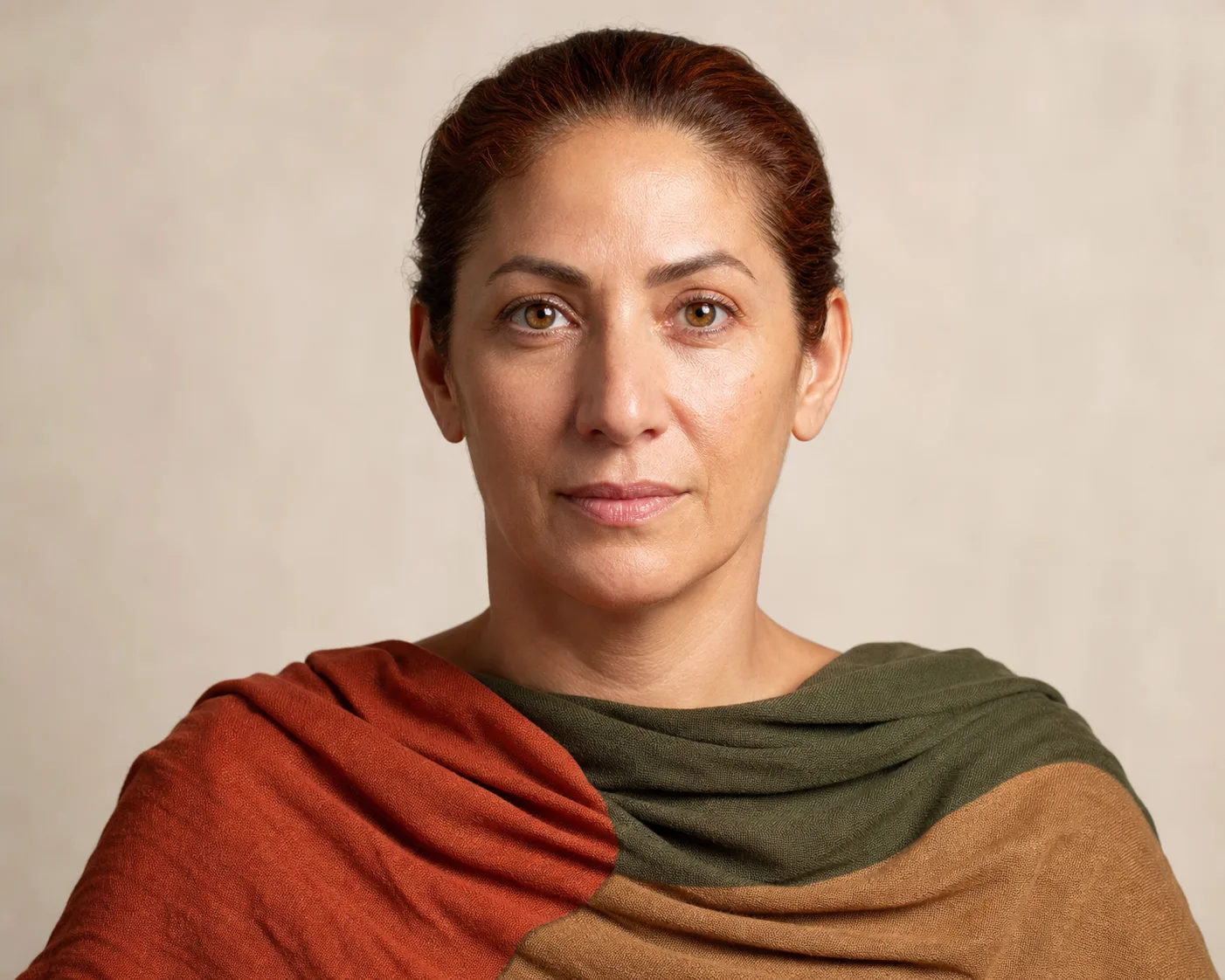
These are the weights the tool applies to each at-home check, not measured optical values. No single check is reliable on its own, which is exactly why the tool runs all four and weighs them against each other rather than asking one question and announcing an answer.
Olive skin carries a green or grey cast in addition to its warm or cool lean. It is the undertone most often left out of the standard three, and the one most poorly served by foundation ranges, which is why it is included here as a category of its own rather than folded into neutral.
The clearest sign is not on the wrist, it is in the makeup bag. If warm golden foundation goes orange on you and cool pink foundation goes grey, and neither ever quite looks like skin, olive is the likely explanation. That specific pair of failures is close to diagnostic. Searches for an olive skin tone usually mean this: a green cast over a warm or neutral base.
How olive shows itself across the checks
Veins, weighted at 2. Olive skin usually reads green on this check, which is why it is so often filed as warm. The vein check alone cannot separate olive from warm, and this is the main reason the tool requires green veins plus mixed evidence elsewhere before calling olive.
Jewellery, weighted at 1.5. Both metals often look acceptable, similar to neutral, though gold tends to sit slightly better.
Sun response, weighted at 1. Olive skin usually tans readily and burns less than its apparent lightness suggests.
White fabric, weighted at 1. This is the check that gives it away. Against pure optical white, olive skin often looks distinctly green or grey rather than simply warm or sallow.
Both produce mixed results. Neutral foundations simply look fine on neutral skin. On olive skin they look flat or grey, because the green cast is not being accounted for.
The principle behind every suggestion below
The green cast has to be answered rather than ignored, so colours carrying some green or gold in them harmonise, and flat pink or pure grey tones expose it.
Colour and makeup
The single most useful piece of information here is about foundation, because it is where olive skin is failed most often and where the fix is most concrete.
Worth reaching for
Foundation described as olive, or with a G, O or Y-G in the shade code
Gold jewellery slightly ahead of silver, though both work
Olive green, khaki, teal, terracotta, warm ivory and bronze
Peachy or golden-based blushes rather than flat cool pinks
Works against it
Pink-based foundation, which turns grey against a green cast
Golden-orange foundation, which pushes the skin orange
Flat pastel pink and pure cool grey next to the face
Being told to pick neutral as a compromise, which usually solves neither problem
Where to look for foundation
Brands with Mediterranean, South Asian, Middle Eastern or Latin American ranges carry more olive shades than mainstream Western ranges do.
This is a supply problem rather than a matching problem. Most large ranges are built on a warm-to-cool axis with no green in them at all, so no shade in the range will ever be right regardless of how carefully you swatch.
Where people go wrong
Being told olive is just warm
The vein check points green for both, so olive gets filed as warm constantly. The two behave completely differently in foundation, which is the practical test that separates them.
Chasing a warmer shade when foundation looks grey
The instinct is to go warmer, which overshoots into orange. The problem is the missing green in the shade, not insufficient warmth, and going warmer cannot fix it.
Avoiding green clothing
It is a common assumption that green next to green-cast skin is a bad idea. In practice olive green and khaki are among the most reliable colours for this undertone, because they harmonise with the cast instead of contrasting against it.
Common questions
Foundation is the clearest test. Warm skin looks right in golden shades. Olive skin turns orange in them and grey in pink ones, and never quite settles in either. If that pattern is familiar, olive is the likely answer even though your veins read green.
Yes. Olive describes the green cast, not the depth. Very fair olive skin exists and is particularly badly served by foundation ranges, because the lightest shades in most ranges are built pink.
Because warm skin also shows green veins, and warm is far more common. Calling olive on the vein check alone would misclassify a large number of warm-undertoned people. The tool requires green veins together with mixed evidence from the other checks before it returns olive.
The safety note explaining that the sun-response clue does not call for UV exposure.
Last checked 2026-07-31
Not sure this is you?
The tool runs all four checks, weighs them against each other, and tells you which ones disagreed. When the evidence is mixed that is the useful information, because mixed evidence is what neutral actually means.