whatsuitsme

Deep Winter colour palette

Deep at 1.00 with high contrast at 1.00, on a cool base, and colours that stay clear rather than muted.

Last reviewed 2 August 2026By Sravya

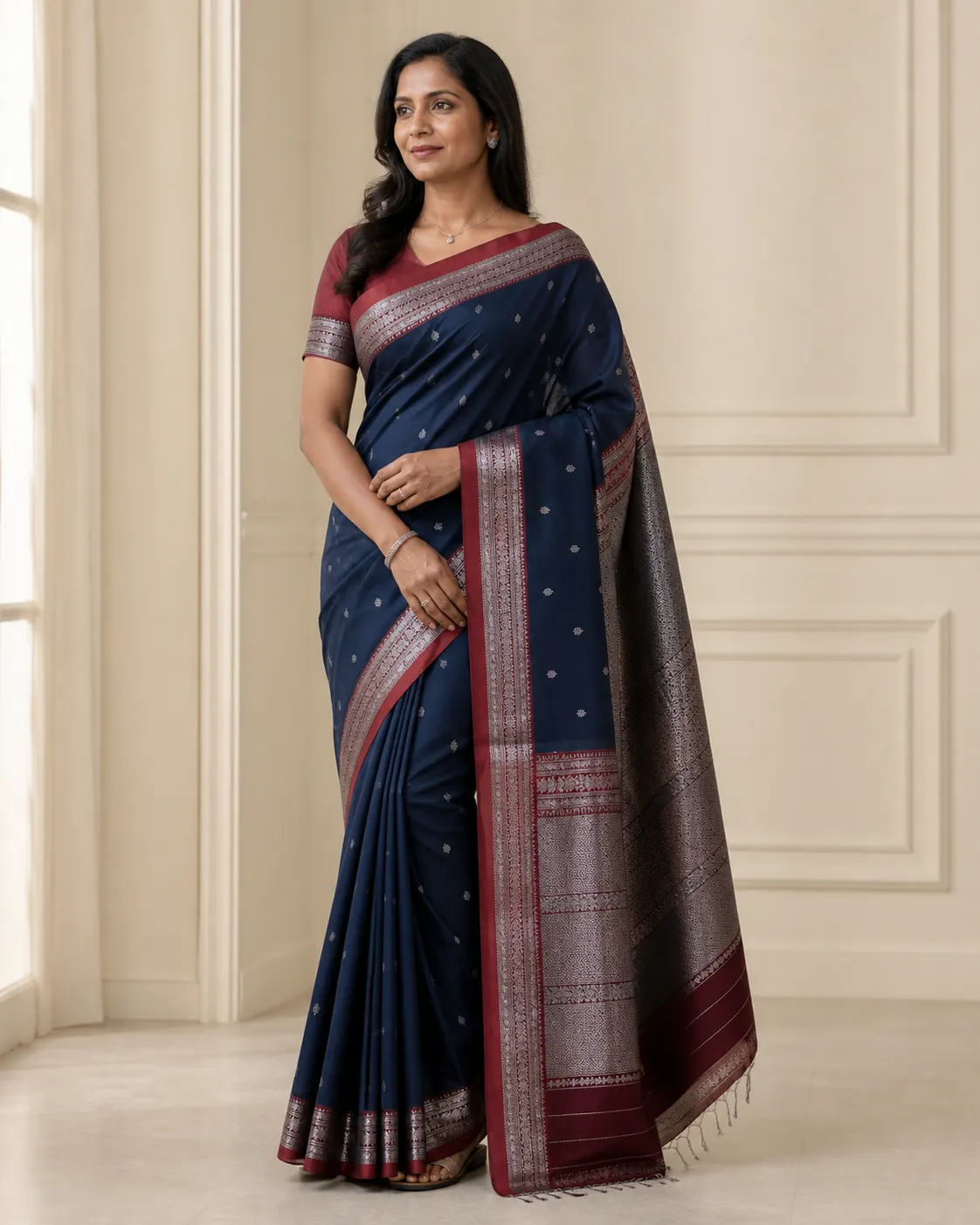
Editorial saree reference for the deep winter palette

The four scores that place it

colour
Temperature
-0.35

slight cool, blue base

Depth
1.00

deep colouring

Contrast
1.00

high, striking

Chroma
0.70

clear, bright

The palette

  • AubergineAubergine, #551A45
  • NavyNavy, #123B67
  • PeacockPeacock, #006B68
  • CrimsonCrimson, #9A1635
  • InkInk, #25233F
  • IceIce, #D8DCE8

Each axis runs from about -1 to +1 and is scored separately. These are editorial centres for a repeatable comparison, and the hex values are screen references rather than measured standards. Scoring the four apart is what lets the tool tell you which single call was the shaky one, instead of handing you a season and no reasoning.

Find my colour season

Deep Winter combines maximum depth with maximum contrast. Colouring is dark and striking: dark brown or black hair, eyes that read clearly against the skin, and a complexion that can be fair or deep but always sits sharply apart from the hair.

Temperature is a moderate cool lean at -0.35 rather than the full -1.00 of Cool Winter, so depth and contrast lead here and coolness is the tiebreaker. This is the winter season that handles the deepest colours best.

How to check whether this is your season

Check contrast first. If your hair is dramatically darker than your skin, you are in a high-contrast season and most of the twelve are already ruled out.

Confirm depth. Dark colours should look natural on you and pastels should look weak.

Then temperature, moderately. Hold a cool aubergine against your face, then a warm chestnut. Deep Winter prefers the aubergine, though not as strongly as a Cool Winter would.

What it gets mistaken for

  • Mistaken for

    Deep Autumn

    Same depth at 1.00. Deep Winter is cool at -0.35 and clear at 0.70; Deep Autumn is warm at 0.55 and muted at -0.65.

  • Mistaken for

    Cool Winter

    Cool Winter is more strongly cool at -1.00 and less deep at 0.30. If mid-depth cool brights suit better than very dark colours, look there.

Every season, every colour

12 seasons · 72 shades

These are the actual palettes the colour tool works from, not a sample. Point at one to hold it. Twelve seasons rather than the old four, because four cannot separate someone light and cool from someone deep and cool.

The principle behind every suggestion below

Depth and clarity together. This is one of the few seasons where genuinely dark, saturated colour is the natural home rather than a risk.

Your colours

Deep Winter is the season black was made for. It is also the one most likely to be wearing black already, which means the useful advice is usually about what else works.

Worth reaching for

  • Aubergine, deep purple and true navy
  • Peacock, deep emerald and dark teal
  • Crimson and true blue-based red
  • Black and icy white as genuine neutrals

Works against it

  • Muted, dusty or greyed colours
  • Warm earth tones such as rust, camel and olive
  • Light warm pastels
  • Beige, which disappears entirely

The icy accent

Pair a very dark colour with an icy pastel rather than a mid-tone.

At contrast 1.00 the colouring is built on sharp difference. Icy pink or icy blue against deep navy repeats that structure, where a mid-tone flattens it. This pairing is specific to the winter seasons.

Where people go wrong

  • Wearing only black

    It works, which is why it becomes the default and the wardrobe stops there. The palette has considerable range in deep jewel colours, and using them is what stops the season looking severe.

  • Adding warm earth tones

    Camel, rust and olive are the clearest mismatch for this palette. They are muted and warm where the season is clear and cool.

  • Being told high contrast means black and white only

    High contrast means light against dark, not specifically black against white. Deep navy with icy pink is the same structure and considerably more interesting.

Common questions

Sources and review record

Not sure this is you?

The tool scores temperature, depth, contrast and chroma separately across all twelve seasons, then shows which of the four calls was closest to a boundary. That is the honest answer to why different sites give you different seasons.

Find my colour season

The twelve colour seasons

Or see all the guides.