whatsuitsme

Heart face shape

The forehead is as wide as or wider than the cheekbones, near 1.00, while the jaw is much narrower, near 0.72.

Last reviewed 10 August 2026By Sravya

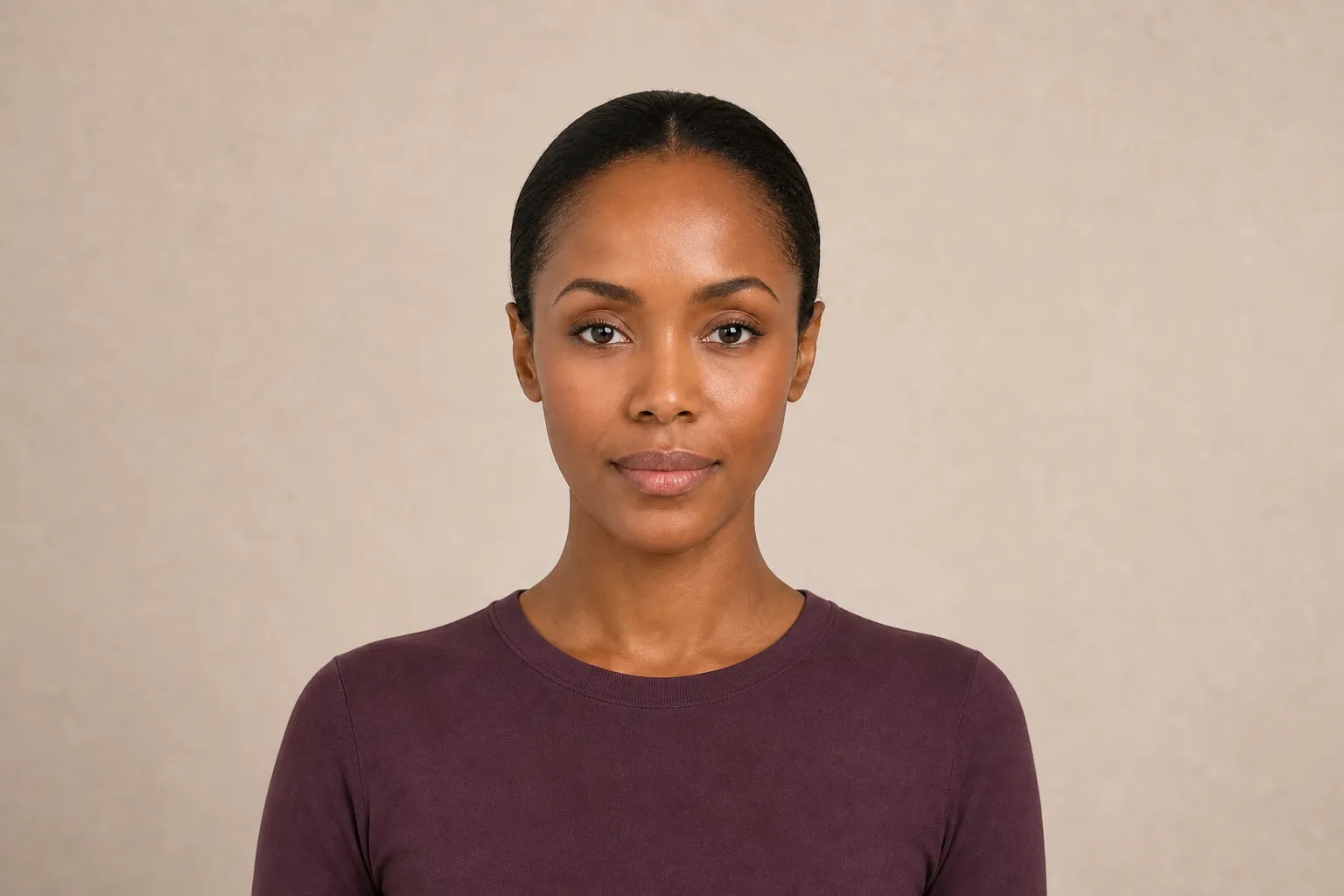
Editorial portrait illustrating heart face proportions

The ratios that define it

face
Length ÷ cheek
1.22

hairline to chin, over cheekbone width

Forehead ÷ cheek
1.00

widest brow, over cheekbone width

Jaw ÷ cheek
0.72

jaw angles, over cheekbone width

These are editorial thresholds for a repeatable comparison, not anthropometric norms. Landing a few hundredths away from a figure means nothing. Landing a long way from one of them is what decides the shape.

Work out my face shape

A heart face is widest at the forehead and narrows through the cheekbones to a comparatively small chin. The taper is the point. Where an oval narrows gently, a heart narrows noticeably, so the lower third of the face carries much less width than the upper third.

A widow's peak at the hairline often gets treated as the definition of this shape. It is not. Plenty of heart faces have a straight hairline and plenty of other shapes have a peak. The proportion between brow width and jaw width is what decides it.

How to check whether this is your shape

Measure the forehead at its widest, the cheekbones at their widest, and the jaw from angle to angle. On a heart face the forehead figure will be close to or above the cheekbone figure.

Then compare the jaw with the cheekbones. The threshold used here puts a heart jaw near 0.72 of cheekbone width, which is a large gap and usually obvious once measured. If the jaw is only slightly narrower, the shape is closer to oval.

Take the measurement with hair fully off the face. A fringe or hair worn forward at the temples hides exactly the width this shape is defined by, and that single error sends more heart faces to a wrong answer than anything else.
What it gets mistaken for

  • Mistaken for

    diamond

    Diamond is widest at the cheekbones with a narrow forehead, near 0.78. Heart is widest at the forehead. If the brow is narrower than the cheekbones, it is diamond.

  • Mistaken for

    oval

    Oval also tapers, but far less: a jaw near 0.82 of cheekbone width rather than 0.72, and a forehead near 0.92 rather than 1.00.

Where the seven shapes actually sit

measured ratios
ovalroundsquareheartdiamondoblongtrianglelength ÷ cheekbone width →jaw ÷ cheekbone →

Round and square sit 0.04 apart on length and 0.09 apart on jaw. That is the entire difference between them, and it is why two sites can give you two different answers from the same face. Ours shows you where you landed rather than only what it decided.

The principle behind every suggestion below

The width sits high and the weight is missing low, so the useful moves put fullness at and below the jaw and keep bulk away from the temples.

Hair

Worth reaching for

  • A wavy bob or lob finishing below the chin, where the width is needed
  • Long layers that begin near the cheekbone and carry weight down to the jaw
  • A soft side-swept fringe that breaks up forehead width diagonally

Works against it

  • A heavy, blunt fringe, which flattens the forehead into an even wider horizontal band
  • Volume concentrated at the crown and temples with nothing happening lower down

See the cuts for this shape, and the wording to give a stylist.

Say this at the salon

My forehead is wider than my jaw, so I want the fullness sitting at chin level and below, and nothing that adds width up at the temples.

Naming the proportion and what you want done about it gives a stylist something to work with. A photograph of someone else does not, because their hair is not yours.

Glasses

Frames whose visual weight sits low move the eye down towards the narrower part of the face, which is the direction that balances the taper. A heavy browline does the reverse and widens the part that is already widest.

Worth reaching for

  • Aviator frames
  • Bottom-weighted frames
  • Light square frames without heavy brow bars

Works against it

  • Very top-heavy frames that add more width across an already wide brow

See the frame shapes for this face, and the width in millimetres.

Where people go wrong

  • Using a widow's peak as the test

    The hairline shape and the face shape are separate things. Measure the forehead width against the jaw width instead, which is what actually defines the taper.

  • Cutting a full blunt fringe to hide the forehead

    It covers the height of the forehead but keeps its full width, and the straight edge draws a horizontal line across the widest part. A side-swept or curtain fringe reduces the visible width instead of underlining it.

  • Measuring with hair over the temples

    Hair sitting forward at the temples hides the exact width this shape is defined by. Pin everything back before measuring or the result will read as oval.

Common questions

Sources and review record

Not sure this is you?

The tool measures all seven and shows you how close the runner-up came, which is the useful thing when two shapes score near each other.

Work out my face shape

The seven face shapes

Or see all the guides.