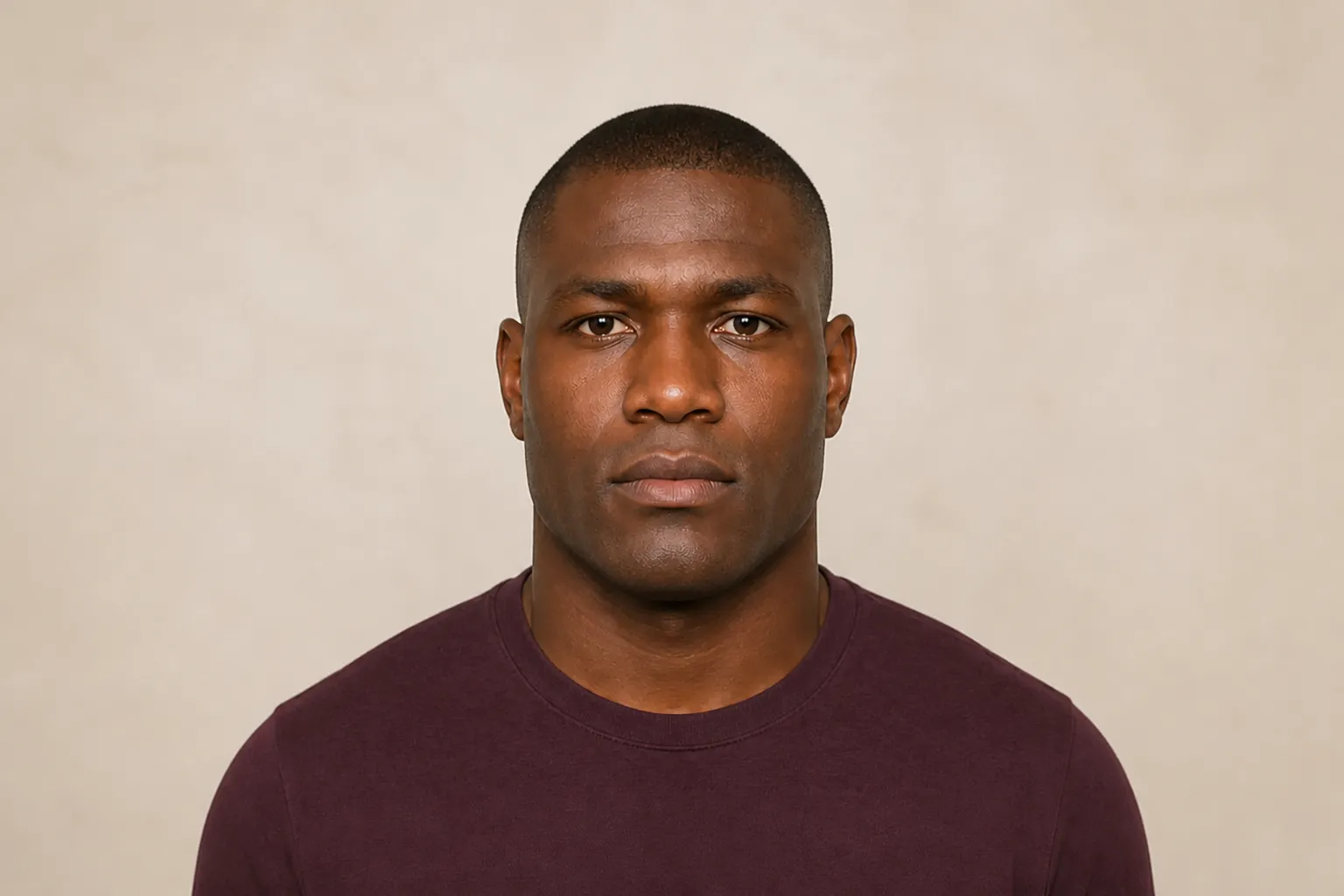
A square face has a jaw, cheekbone and forehead width that are all close to each other, and a jaw with a visible corner at the back rather than a curve. Length and width are fairly close too, so the face reads as a block rather than an oval.
The defining feature is the angle, not the size. A square jaw can be narrow or broad. What makes it square is that the line from below the ear to the chin changes direction at a point instead of curving smoothly, which gives the lower face a horizontal edge.
How to check whether this is your shape
Measure the three widths first: forehead, cheekbones and jaw. On a square face all three land within a few percent of each other. If one is clearly the widest, the shape is something else.
Then check the corner. Trace from just under the earlobe towards the chin. A square jaw has a point where the direction changes. That corner is what separates square from round, because the proportions of the two are almost identical.
The thresholds used here put a square face near 1.10 for length against cheekbone width, 0.96 for forehead and 0.97 for jaw. Compare that with round at 1.06, 0.90 and 0.88. The numbers are close, which is exactly why the jaw corner does most of the work.