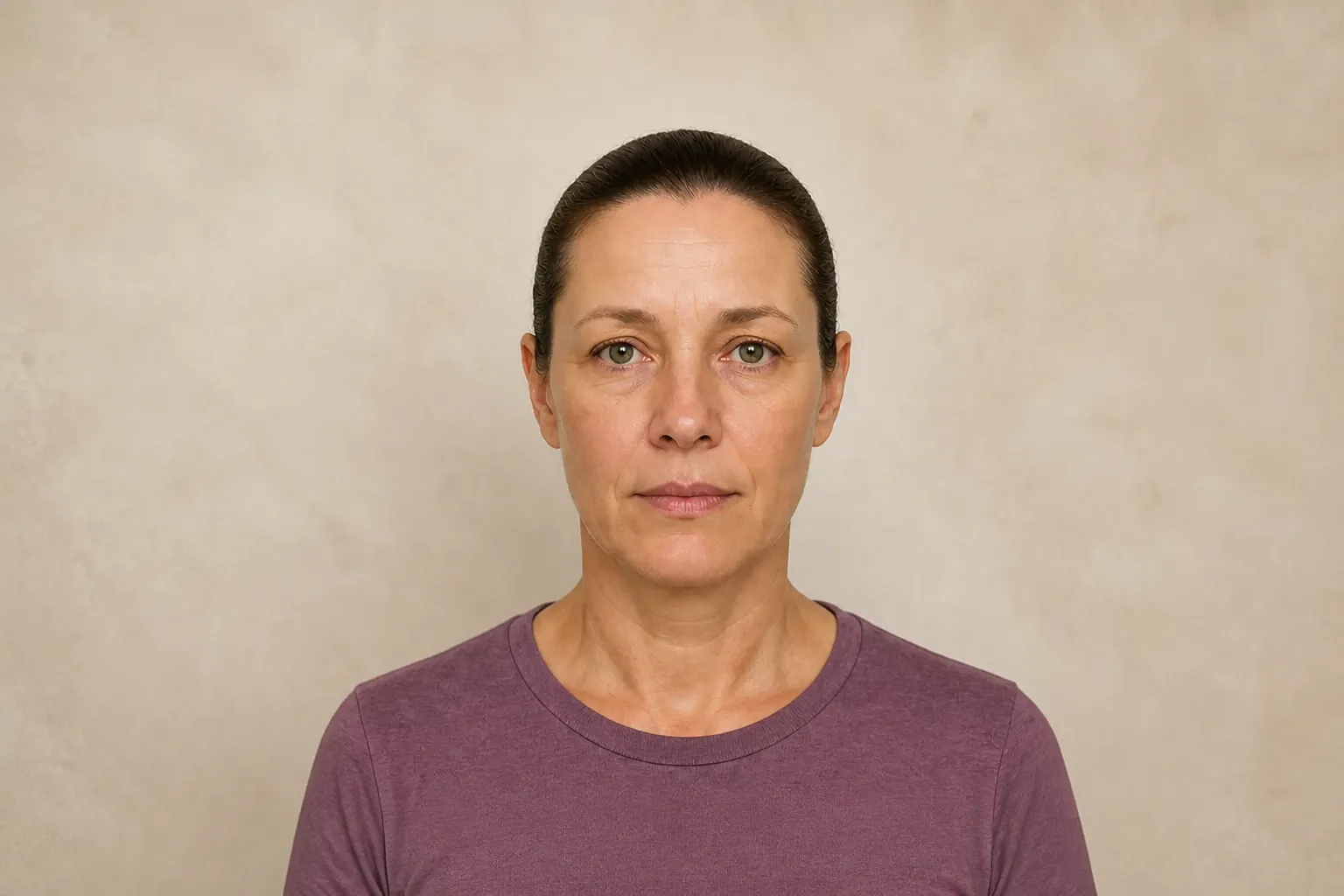
An oval face is longer than it is wide, with the cheekbones as the widest point and a jaw that narrows gently below them. Nothing about the outline is emphatic. The forehead is a little narrower than the cheekbones, the jaw is narrower again, and the transition between them is gradual rather than angular.
Oval is the shape most often described as the one everything suits, and that description is close to true but for a duller reason than it sounds. Because no single area dominates, very few cuts or frames create an obvious imbalance. That widens the field of what works. It does not mean every choice is equally good, and it does not mean face shape should be the deciding factor over hair texture, height or what someone actually wants to wear.
How to check whether this is your shape
Pull your hair back and face a mirror straight on, with the camera or your eyes at the same height as your own eyes. Looking up or down changes apparent face length more than almost any other error.
Measure four things: the length from hairline to the base of the chin, the width across the cheekbones at their widest, the width across the forehead about halfway between the brows and the hairline, and the width across the jaw from angle to angle.
Divide each width into the length. An oval sits near 1.38 for length against cheekbone width, near 0.92 for forehead against cheekbone, and near 0.82 for jaw against cheekbone. Being a few hundredths away from those figures means nothing; being a long way from one of them is what matters.