whatsuitsme

Round face shape

Face length and cheekbone width are close, near 1.06 against each other, and the jaw curves rather than angles.

Last reviewed 10 August 2026By Sravya

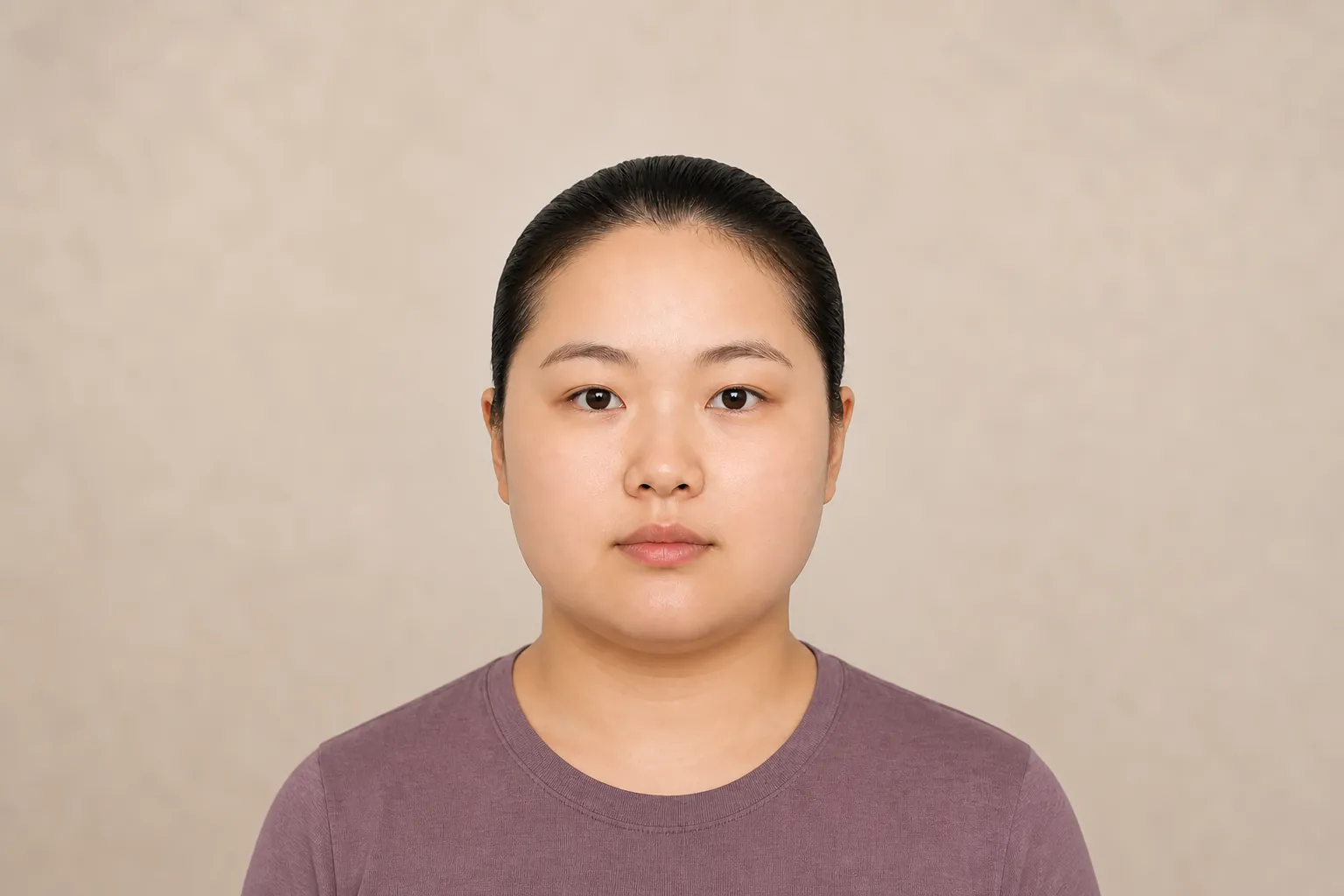
Editorial portrait illustrating round face proportions

The ratios that define it

face
Length ÷ cheek
1.06

hairline to chin, over cheekbone width

Forehead ÷ cheek
0.90

widest brow, over cheekbone width

Jaw ÷ cheek
0.88

jaw angles, over cheekbone width

These are editorial thresholds for a repeatable comparison, not anthropometric norms. Landing a few hundredths away from a figure means nothing. Landing a long way from one of them is what decides the shape.

Work out my face shape

A round face has length and width that are close to equal, with soft curves where other shapes have corners. The cheeks are the fullest part, the jaw is rounded rather than angled, and the hairline tends to curve too. The overall impression is of a circle rather than a rectangle.

Round is not the same as heavy, and the two get confused constantly. Face shape describes the outline created by bone and soft tissue at the forehead, cheekbones and jaw. People at very different weights have round faces, and losing or gaining weight changes fullness without changing the underlying proportion much.

How to check whether this is your shape

Measure hairline to chin, then the width across the cheekbones. If those two numbers are within about ten percent of each other, the face is reading round or square rather than long.

Now look at the jaw. Run a finger from below the ear down to the chin. A round face follows a continuous curve with no corner to find. A square face has a distinct angle at the back of the jaw where the direction changes.

The thresholds used here put a round face near 1.06 for length against cheekbone width, near 0.90 for forehead against cheekbone, and near 0.88 for jaw against cheekbone. The jaw figure sits close to the square figure, which is why the curve test matters more than the number here.
What it gets mistaken for

  • Mistaken for

    square

    The proportions are nearly identical. The difference is the jaw corner: square has a visible angle, round does not. Feel for it rather than looking, because hair and lighting hide it.

  • Mistaken for

    oval

    Oval runs noticeably longer at about 1.38 against cheekbone width. If length clearly beats width, it is not round.

Where the seven shapes actually sit

measured ratios
ovalroundsquareheartdiamondoblongtrianglelength ÷ cheekbone width →jaw ÷ cheekbone →

Round and square sit 0.04 apart on length and 0.09 apart on jaw. That is the entire difference between them, and it is why two sites can give you two different answers from the same face. Ours shows you where you landed rather than only what it decided.

The principle behind every suggestion below

Width at cheek level repeats what is already the widest line, so the useful moves add vertical length and keep volume off the sides.

Hair

Worth reaching for

  • Layers that build a little height at the crown
  • A tapered short cut rather than a rounded one
  • Texture that draws the eye up and down rather than out

Works against it

  • A one-length cut with its fullness sitting at cheek level
  • Wide, rounded volume level with the widest part of the face

See the cuts for this shape, and the wording to give a stylist.

Say this at the salon

My face is about as wide as it is long, so I want a bit of height through the top and the weight kept off the sides at cheek level.

Naming the proportion and what you want done about it gives a stylist something to work with. A photograph of someone else does not, because their hair is not yours.

Glasses

A round frame on a round face repeats the outline at a smaller scale, so the two curves reinforce each other. Straight top lines and defined corners introduce the angle the face does not have, which is what creates the contrast.

Worth reaching for

  • Rectangular frames
  • Square frames
  • Angular geometric frames

Works against it

  • Small round frames that trace the same curve as the face

See the frame shapes for this face, and the width in millimetres.

Where people go wrong

  • Assuming round means overweight

    These are different things. The shape is set by the proportion of length to width and by whether the jaw turns a corner. Plenty of very slim people have round faces and plenty of larger people do not.

  • Adding height and nothing else

    Height at the crown helps, but stacking it on while leaving the sides full just makes the face taller and equally wide. The side volume has to come down at the same time or the ratio does not move.

  • Choosing a chin-length blunt bob

    It ends at the widest point of the face and cuts a horizontal line straight across it. If a bob is what you want, taking it past the jaw changes the effect completely.

Common questions

Sources and review record

Not sure this is you?

The tool measures all seven and shows you how close the runner-up came, which is the useful thing when two shapes score near each other.

Work out my face shape

The seven face shapes

Or see all the guides.